
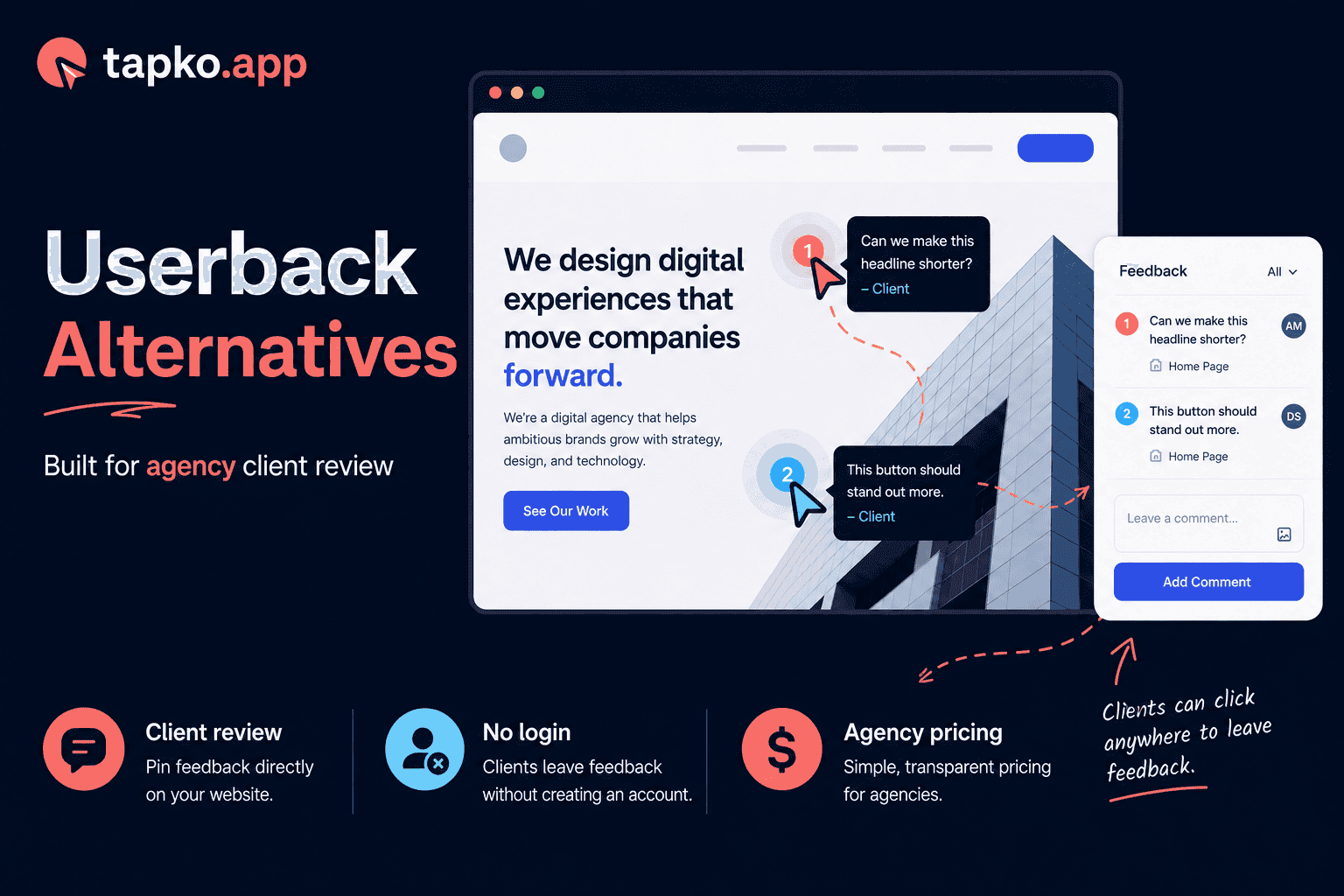
Userback is a strong tool if you're a SaaS team watching how users move through your product. It's a weaker fit if you're an agency handing a live client site to a marketing manager who has never used a feedback widget before. If you landed here because Userback felt like the wrong shape for your agency, here's an honest look at your options.
Why agencies look for Userback alternatives
Userback's core strength is session replay: watching how a real user clicked through your product, paired with an in-app widget that collects sentiment and bug reports. That's built for a product team improving their own SaaS, with a steady stream of logged-in users.
An agency's situation is different. One client, one site, a handful of review rounds before launch. The client isn't a logged-in user of your product — they're a business owner who just wants to click on the thing that looks wrong and move on with their day. A widget built around in-app analytics doesn't solve that problem any better than a BugHerd or a Jira ticket queue would.
The six best Userback alternatives
1. tapko.app — best for client-facing agencies
tapko.app is built specifically for the agency-client relationship. Clients don't need an account — they open a shared link, click anywhere on the live site, and leave a comment. The tool automatically captures the screenshot, URL, device, browser, and viewport. Your team sees everything in one dashboard.
Pricing: First project free forever. Pro plan with unlimited projects at $49/month.
Best for: Agencies with non-technical clients who won't create accounts.
Integrations: ClickUp, Slack, Jira, Asana, Notion, Trello.
2. BugHerd — best for teams that want task management built in
BugHerd has been around since 2012 and pairs visual feedback with its own project management layer. It covers more ground than a pure annotation tool, but clients need to create an account and log in before leaving feedback — an extra step that costs feedback volume with busy, non-technical clients.
Best for: Teams that want bug tracking and task management in one tool.
Not ideal for: Agencies whose clients won't sign up for another account.
3. Marker.io — best for dev teams
Marker.io requires a script tag and a browser extension for reporters. It's feature-rich and integrates well with developer tools, but clients need to install the extension or be comfortable with browser-based reporting. The client UX is more complex than tapko.app.
Best for: Agencies where clients or QA testers are comfortable with browser tools.
Not ideal for: Small business clients who just want to click on what bothers them.
4. Pastel — best for design review
Pastel is purpose-built for website design feedback. Clients open a Pastel link, no account required, and click to annotate. It's simple and fast, but lacks project management depth. Best for one-time design approval, less suited for ongoing bug tracking after launch.
Best for: One-time design approval cycles on static pages.
Not ideal for: Ongoing bug reporting or multi-page web applications.
5. Usersnap — best for internal QA and surveys
Usersnap is a flexible feedback widget most commonly used by SaaS and product teams for internal QA and in-app micro-surveys. It supports screenshot annotation and integrates with most PM tools, but reporters generally need to be invited into a project rather than clicking a shared link — closer to Userback's audience than an agency's client.
Best for: Product teams collecting internal QA feedback alongside NPS surveys.
Not ideal for: Agencies who want a zero-invite, purpose-built client reporting flow.
6. GoVisually — best for creative asset approval
GoVisually is built for proofing creative assets — PDFs, images, videos, and static designs — rather than live websites. It's a strong fit if your review cycle happens on files before a site ships, but it isn't designed to capture bugs on a live, interactive product.
Best for: Creative and marketing teams approving static assets before launch.
Not ideal for: Bug tracking on a live website or web app.
How Userback stacks up against the alternatives
| Tool | Starting price | Client setup | Best for |
|---|---|---|---|
| tapko.app | Free / $49/mo | None | Client-facing agencies |
| Userback | See their pricing page | Script tag | Product teams |
| BugHerd | See their pricing page | Account required | Teams wanting PM built in |
| Marker.io | See their pricing page | Extension or script | Dev teams |
| Pastel | See their pricing page | Link-based (no account) | Design review |
| Usersnap | See their pricing page | Invite-based | Internal QA / surveys |
| GoVisually | See their pricing page | Account required | Creative asset approval |
How to choose the right Userback alternative
The right choice depends on one question: who is leaving feedback, and are they a user of your product or a client of your agency?
If you're a SaaS team watching your own users and want session replay alongside feedback, Userback does that well — that's what it was built for. If your clients are business owners, marketers, or anyone who isn't paid to test software, you need something with zero client setup — and tapko.app is your best option.
The most expensive feedback tool is the one your clients don't use. A product-analytics platform that sits unopened because a client never installed the widget costs more than an affordable tool they actually click on.
Frequently Asked Questions
What is the best Userback alternative for agencies?
tapko.app is the best Userback alternative for agencies with non-technical clients. It includes unlimited projects at $49/month and requires zero client setup. Clients click on the live site without creating an account or installing a widget.
Is Userback good for agencies working with clients?
Userback is built for product teams who want session replay and in-app feedback widgets on their own SaaS product. It works, but it is not built around the agency-client handoff, where a non-technical client just needs to click on a live site and leave a comment.
How does tapko.app pricing compare to Userback?
Why do agencies look for Userback alternatives?
Userback is aimed at SaaS teams tracking product UX across many users, not at agencies collecting feedback from a single client per project. Its in-app widget and session replay features solve a different problem than the live-site annotation agencies need.