
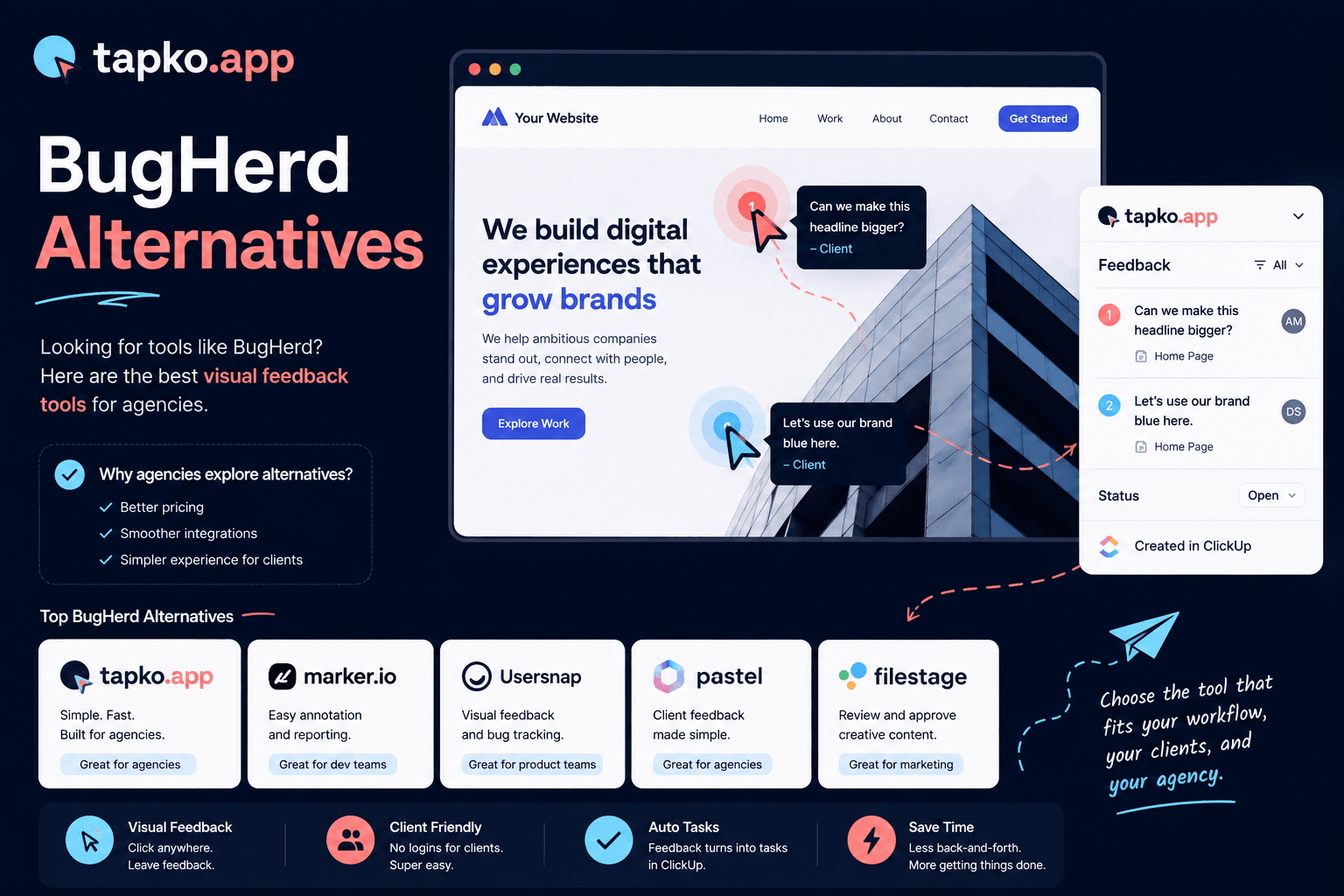
BugHerd has been around since 2012 and is a solid product — but many agencies are paying for features they don't need and complexity their clients don't want. If you are looking for an affordable BugHerd alternative for growing agencies with less client friction, here is an honest breakdown of your options.
Why agencies look for BugHerd alternatives
The most common complaints are pricing and client adoption. BugHerd's embedded portal requires clients to create an account and log in before they can leave feedback. For agencies with busy, non-technical clients, that extra step is enough to kill feedback volume entirely.
BugHerd's pricing is also steep for freelancers and small agencies managing a handful of projects. Tools at that end of the market are built for enterprise teams, not for a two-person studio with 10 client sites.
The seven best BugHerd alternatives
1. tapko.app — best for client-facing agencies
tapko.app is built specifically for the agency-client relationship. Clients don't need an account — they open a shared link, click anywhere on the live site, and leave a comment. The tool automatically captures the screenshot, URL, device, browser, and viewport. Your team sees everything in a clean dashboard.
Pricing: First project free forever. Pro plan with unlimited projects at $49/month.
Best for: Agencies with non-technical clients who won't create accounts.
Integrations: ClickUp, Slack, Jira, Asana, Notion, Trello.
2. Marker.io — best for dev teams
Marker.io requires a script tag and has a browser extension for reporters. It is feature-rich and integrates well with developer tools. The downside: clients need to install the extension or be technical enough to use the browser-based reporter. The client UX is more complex than tapko.app.
Best for: Agencies where clients or QA testers are comfortable with browser tools.
Not ideal for: Small business clients who just want to click on what bothers them.
3. Pastel — best for design review
Pastel is purpose-built for website design feedback. Clients open a Pastel link (no account required) and click to annotate. It is simpler than BugHerd but lacks the project management depth. Best for pure design review — less suited for ongoing bug tracking.
Best for: One-time design approval cycles on static pages.
Not ideal for: Ongoing bug reporting or multi-page web applications.
4. Userback — best for product teams
Userback has strong session replay and user sentiment features. It is more of a product analytics tool than a pure feedback collector. It is aimed more at SaaS products than agency-client relationships.
Best for: Product teams tracking UX across many users.
Not ideal for: Agencies collecting feedback from a single client per project.
5. Usersnap — best for internal QA and surveys
Usersnap is a flexible feedback widget most commonly used by SaaS and product teams for internal QA and in-app micro-surveys. It supports screenshot annotation and integrates with most PM tools, but its client-facing experience isn't built specifically around the agency handoff — reporters generally need to be invited into a project rather than clicking a shared link.
Best for: Product teams collecting internal QA feedback alongside NPS surveys.
Not ideal for: Agencies who want a zero-invite, purpose-built client reporting flow.
6. zipBoard — best for review plus task tracking in one tool
zipBoard combines pin-based visual feedback with a built-in task board, positioning it between a review tool and a project tracker like BugHerd. It covers more ground than a pure annotation tool but asks reviewers to engage with a heavier interface than a single click-to-comment flow.
Best for: Teams that want review and task tracking bundled into one tool.
Not ideal for: Agencies wanting the lightest possible client-facing flow.
7. GoVisually — best for creative asset approval
GoVisually is built for proofing creative assets — PDFs, images, videos, and static designs — rather than live websites. It's a strong fit if your review cycle happens on files before a site ships, but it isn't designed to capture bugs on a live, interactive product.
Best for: Creative and marketing teams approving static assets before launch.
Not ideal for: Bug tracking on a live website or web app.
How BugHerd stacks up against the alternatives
| Tool | Starting price | Client setup | Best for |
|---|---|---|---|
| tapko.app | Free / $49/mo | None | Client-facing agencies |
| BugHerd | See their pricing page | Account required | Enterprise teams |
| Marker.io | See their pricing page | Extension or script | Dev teams |
| Pastel | See their pricing page | Link-based (no account) | Design review |
| Userback | See their pricing page | Script tag | Product teams |
| Usersnap | See their pricing page | Invite-based | Internal QA / surveys |
| zipBoard | See their pricing page | Account required | Review + task tracking |
| GoVisually | See their pricing page | Account required | Creative asset approval |
What BugHerd costs once you outgrow a tier
BugHerd's per-seat pricing means the bill grows every time you add a teammate. Move the sliders below to see what your actual agency size would pay on each tool.
How to choose the right BugHerd alternative
The right choice depends on one question: who is leaving feedback?
If your clients are product teams or QA testers who are comfortable with browser tools, Marker.io is a solid choice at a lower price than BugHerd. If your clients are business owners, marketers, or anyone who isn't paid to test software, you need something with zero client setup — and tapko.app is your best option.
The most expensive feedback tool is the one your clients don't use. A premium tool that clients ignore because the account creation step is one step too many costs more than an affordable tool they actually open.
Frequently Asked Questions
What is the best BugHerd alternative for agencies?
tapko.app is the best BugHerd alternative for agencies with non-technical clients. It includes unlimited projects at $49/month and requires zero client setup. Clients click on the live site without creating an account or installing anything.
Is there a BugHerd alternative that doesn't require client accounts?
How does tapko.app pricing compare to BugHerd?
Why do agencies look for BugHerd alternatives?
The most common reasons are pricing and client adoption. BugHerd requires clients to create an account before leaving feedback, which reduces report volume. Its pricing is also steep for small agencies that don't need its full project management layer.